A Purple World Once Was

Declan Kennedy
| 13-01-2026
 · Science Team
Staring at a lush forest canopy, it's easy to think green is the default color of life. It dominates our world, a testament to chlorophyll's power. But a few years back, while visiting a lab studying organisms in extreme environments, I saw something that shook that assumption.
In a sealed container, thriving under the dim glow of a special lamp, was a deep purple microbial mat. The scientist noted casually, "This could've been the first color scheme." That moment stuck with me. What if Earth's dominant hue wasn't always, and didn't have to be, green?
This isn't science fiction; it's a compelling scientific thought experiment known as the Purple Earth Hypothesis.
The Core Idea: A Different Solar Strategy
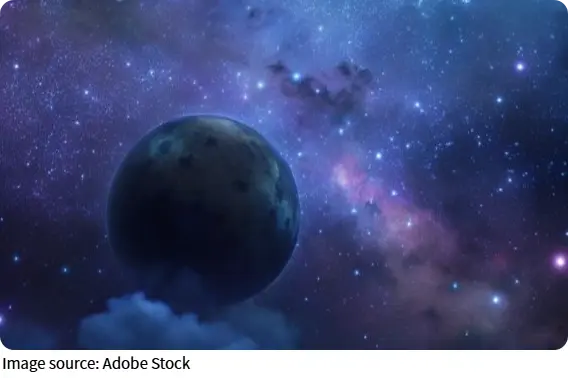
The hypothesis, proposed by scientists like Nancy Kiang and others, suggests that before green plants conquered the land, the planet's surface might have had a widespread purple tint. This wouldn't be from flowers, but from primitive microbes using a molecule other than chlorophyll for photosynthesis. Chlorophyll, for all its success, has a major quirk: it's terrible at absorbing green light. It reflects it, which is why plants look green to us. The purple hypothesis asks: what if early life used a molecule that was a "green absorber" instead? Retinal-based pigments, found in today's salt-loving halobacteria and some other microbes, do exactly that. They absorb green light efficiently and reflect red and blue, giving them a purple appearance. On an ancient Earth with a different atmospheric composition and a younger, dimmer sun, these purple pigments could have been a more efficient way to capture the available light spectrum, potentially making them the planet's first dominant life form.
The Chemical and Evolutionary Backbone
To understand why purple could have been feasible, we need to look at the chemistry. Chlorophyll-based photosynthesis is a complex, multi-step process that produces oxygen. Retinal-based phototrophy, however, is a simpler, one-step system. It uses light energy directly to pump protons across a membrane, creating cellular energy without producing oxygen. In the anoxic (oxygen-free) conditions of early Earth, this simpler system had advantages. The hypothesis doesn't claim purple life did dominate; it argues that the conditions were ripe for it. It forces us to consider evolution not as a straight line to green plants, but as a branching tree where different solutions competed. The eventual rise of cyanobacteria (which use chlorophyll and produce oxygen) and the Great Oxidation Event they caused might have been the catastrophic environmental shift that made the purple, retinal-based world untenable, pushing those life forms to the extreme margins—like salt flats and deep-sea vents—where some still persist today.
Implications Beyond Our Pale Purple Dot
The real power of this hypothesis isn't about rewriting Earth's history books with a purple crayon. It's about expanding our imagination for life elsewhere in the universe. When we search for habitable exoplanets, we often look for a "green edge" in their reflected light spectrum, a sign of chlorophyll. The Purple Earth Hypothesis warns us that this is an Earth-centric bias. An alien biosphere could use a completely different biochemistry. An exoplanet's surface might reflect light in a way that suggests a predominance of purple pigments absorbing green light. Or it could show a "red edge" from entirely different pigments. The hypothesis teaches us that life will use whatever chemical tools work best for its local star and planetary conditions. It encourages astrophysicists and astrobiologists to broaden their search parameters beyond the familiar green signature of our own world.
So, next time you look at a green leaf, see it not just as a symbol of life, but as the winner of an ancient, invisible contest—one that shaped the very air we breathe. The Purple Earth Hypothesis is less a claim about our past and more a lesson in cosmic humility. It reminds us that our world is just one experiment in biology, and that the universe, in all its silent majesty, is likely painting with a far more colorful palette than we've dared to dream. The search for life out there begins by questioning all the assumptions we've grown up with right here.